Stop Guessing.
Choose the Right Rotor Cup — First Time.
Every wrong rotor costs a mill $15,000+ in lost efficiency, rework, and premature wear. This guide — built from 15+ years of OEM engineering — gives you a 7-factor selection framework that eliminates guesswork.
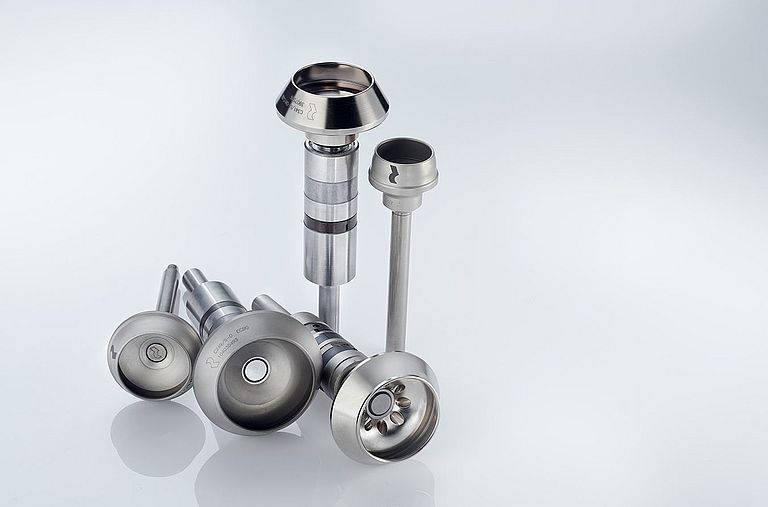
The Hidden Cost of a Wrong Rotor Cup Choice
When a mill runs the wrong rotor, here’s what actually happens — and we’ve seen it across factories in India, Turkey, Uzbekistan, and Southeast Asia:
3–5× Higher Breakage Rate
Mismatched groove + fiber = peeling point instability. Each end-break costs ~45 seconds of lost production. Multiply by 360 spindles.
20–35% Shorter Rotor Life
Wrong coating for the fiber type: abrasive wear accelerates. Chrome rotors last 6 months — Diamond rotors last 3+ years.
Uneven Yarn CV%
Diameter too large for fine counts → insufficient fibers in cross-section → massive CV% variation → fabric quality claims.
Wasted Energy
Running a rotor 20% over its sweet spot increases power draw by 15–20% with zero gain in yarn quality.
Free Download: Rotor Cup Selection Checklist (PDF)
A one-page printable reference — diameter, groove, coating, and speed recommendations by fiber type and yarn count. No guessing.
We’ll email you the PDF instantly + optional rotor specification recommendation. No spam, unsubscribe anytime.
How Rotor (Open-End) Spinning Works
In OE spinning, the rotor cup is where individual fibers are collected, aligned, and twisted into yarn. Understanding this mechanism is essential to making the right selection.
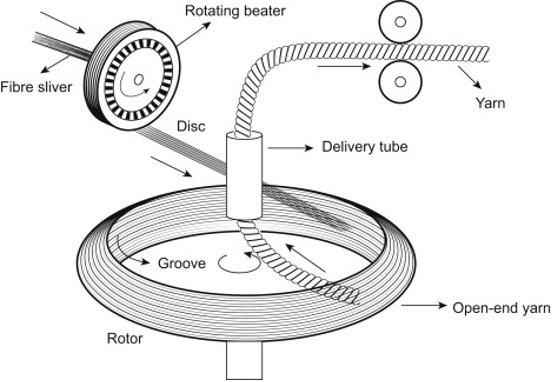
- Sliver feed — carded or drawn sliver enters via feed roller
- Opening — combing roller separates individual fibers
- Fiber transport — airflow carries fibers into the rotor
- Fiber collection — centrifugal force deposits fibers into the rotor groove
- Twist insertion — each rotor revolution = one twist turn
- Yarn withdrawal — formed yarn exits the doffing tube, wound onto a package
The 7 Decision Factors (Before You Buy)
Every rotor cup spec should answer these seven questions. Use this as your procurement checklist:
1. Fiber Material
Cotton, polyester, viscose, or recycled — each demands different groove geometry and coating.
Rotor Cup by Fiber Type →2. Yarn Count (Ne)
Fine yarns need small diameters; coarse yarns need large diameters. The count drives diameter choice.
Rotor Cup by Yarn Count →3. Rotor Diameter
31 mm to 46 mm — diameter determines fiber capacity, twist efficiency, and achievable fineness.
Diameter Selection Guide →4. Groove Design
V, U, T, G, GT — the groove profile controls fiber alignment, hairiness, and strength.
Groove Type Comparison →5. Coating Technology
Diamond (DN), Ceramic, Hard Chrome — coating determines wear life and fiber compatibility.
Coating Comparison →6. Working Speed
Max speed ≠ production speed. Running at 80–90% extends bearing life 2–3×.
Speed Guide →7. Machine Model
Rieter, Schlafhorst Autocoro, Saurer BD, Taitan, Jingwei, Rifa — each has specific rotor requirements.
Machine Compatibility →1. Match Your Rotor Cup to the Fiber Material
The fiber type determines every downstream choice. Start here.
Cotton
Short fibers, dusty, prone to groove buildup.
- Coating: Diamond (DN)
- Groove: U or T for medium counts
- Watch for: fly waste accumulation
Polyester
High strength, abrasive, generates heat.
- Coating: Diamond or Hard Chrome
- Groove: Open V-groove
- Watch for: thermal expansion
Viscose
Smooth surface, tends to adhere to rotor wall.
- Coating: Ceramic or anti-adhesion
- Groove: U-groove
- Watch for: sticky deposits
Recycled Fiber
High impurity, inconsistent length, heavy abrasion.
- Coating: Diamond DN (HV 10K)
- Groove: Wide U or GT
- Watch for: groove clogging

Need help matching coating to your fiber?
Tell us your fiber type + machine model — we’ll recommend the optimal coating within 24 hours.
2. Yarn Count Drives the Diameter Decision
The rule: finer yarns = smaller diameter; coarser yarns = larger diameter. Driven by the ~80–100 fiber minimum per cross-section for stable OE spinning.
| Diameter | Yarn Count | Typical Application | Max Speed |
|---|---|---|---|
| 31 mm | Ne 30–40+ | Fine knit, shirting, high-end apparel | 130–150K rpm |
| 33 mm | Ne 24–36 | Medium-fine knit, lightweight woven | 120–140K rpm |
| 36 mm | Ne 16–30 | Medium — T-shirts, sheeting, terry (≈60% of global OE) | 100–120K rpm |
| 40 mm | Ne 10–20 | Medium-coarse — denim, workwear, towels | 85–105K rpm |
| 46 mm | Ne 3–10 | Coarse — heavy denim, carpet, recycled fiber | 65–85K rpm |
📖 Full guide: How Does Diameter Affect Yarn Quality?
3. Groove Design: The Heart of Fiber Control
The groove profile controls fiber transfer, yarn structure, hairiness, and strength.

| Groove | Profile | Best Count | Key Traits | Common On |
|---|---|---|---|---|
| V-Groove | Sharp, narrow V | Ne 30–40 | Excellent fiber alignment, low hairiness | Rieter R-series, newer Autocoro |
| U-Groove | Wide, rounded U | Ne 10–30 | Good fiber capacity, balanced twist | Schlafhorst SE7–12, older BD |
| T-Groove | Flat-bottom T | Ne 16–40 | Voluminous yarn, soft hand for knits | Rieter, Saurer BD |
| G-Groove | Asymmetrical G | Ne 16–40 | Balanced flow, good for cotton blends | Rieter R20–70, BT series |
| GT-Groove | Combined G+T | Ne 3–30 | Wide window, good twist retention | Rieter |
📖 Full guide: V Groove vs U Groove vs Special Designs
4. Coating Technology: Wear Resistance = Rotor Life
The right coating can extend rotor life 3–5×.
| Coating | Hardness | Wear | Best Application | Life vs Base |
|---|---|---|---|---|
| Diamond (DN) | HV 8,000–10,000 | ★★★★★ | All fibers, high-speed, recycled, abrasive | 5–8× |
| Diamond-Nickel | HV 6,000–8,000 | ★★★★ | Cotton, cotton-poly, medium speed | 4–6× |
| Ceramic | HV 2,000–3,000 | ★★★ | Viscose, low-adhesion needs | 2–3× |
| Hard Chrome | HV 800–1,000 | ★★ | General, low-speed, budget | 1× (baseline) |
📖 Full guide: Diamond vs Ceramic vs Hard Chrome
5. Maximum Speed ≠ Recommended Working Speed
A rotor rated at 180,000 rpm max should run at 80–90% of that in production.
100% Max Speed
- Bearing life −50–70%
- Vibration → uneven yarn
- Heat degrades coating
- Energy spikes non-linearly
- End-breakage surges
80–90% Max Speed
- Bearing life +2–3×
- Stable, consistent twist
- Lower energy per kg yarn
- Predictable maintenance
- Acceptable breakage rate
Example: 36 mm rotor @ 120,000 rpm max → operate at 96,000–108,000 rpm.
📖 Full guide: Complete Rotor Speed vs Working Speed
6. Machine Model Compatibility
The rotor must match your spin box design, bearing type, and drive system.

| Brand | Key Models | Rotor Series | Diameter | Coating |
|---|---|---|---|---|
| Rieter | R20, R35–37, R60–70, BT923 | UD, S, T, G, GT | 31–46 mm | Diamond, Ceramic, Chrome |
| Schlafhorst | Autocoro SE7–12, AC8–11 | T3, T4, T5, B series | 33–46 mm | Diamond, DN-Ni, Belcoro |
| Saurer BD | BD 6–8, BD 448/480 | T3DN, T4DN | 33–46 mm | Diamond, Chrome |
| Taitan | TQF268/368/568 | Rieter/Schlafhorst compatible | 33–43 mm | Diamond, Chrome |
| Jingwei/Rifa | JWF, RF series | OEM-compatible | 33–43 mm | Diamond, Ceramic, Chrome |
Quick Reference: Rotor Selection by Application
| Application | Count | Fiber | Diam | Groove | Coating | Speed |
|---|---|---|---|---|---|---|
| Fine knit T-shirt | Ne 30–36 | Cotton | 33 mm | T / V | Diamond | 110K |
| Denim (weft) | Ne 10–16 | Cotton | 40 mm | U | Diamond | 95K |
| Terry towel | Ne 16–20 | Cotton | 36 mm | T / U | Diamond | 105K |
| Sweatshirt fleece | Ne 10–16 | Cotton/Poly | 40 mm | U / GT | DN-Ni | 95K |
| Heavy workwear | Ne 6–10 | Cotton/Recycled | 46 mm | GT / U | Diamond | 75K |
| Recycled denim | Ne 8–14 | Recycled Cotton | 46 mm | GT | DN (HV 10K) | 70K |
| Polyester sewing | Ne 20–30 | Polyester | 36 mm | V | Diamond | 100K |
| Viscose knit | Ne 24–30 | Viscose | 36 mm | U | Ceramic | 95K |
7. How Long Should a Rotor Cup Last?
Diamond, Cotton, Moderate Speed
3–5 years continuous before groove wear impacts yarn CV%.
Diamond, Poly/Recycled, High Speed
1.5–2.5 years — abrasion accelerates despite DN coating.
Chrome, Any Fiber
6–12 months — not recommended for professional production.
Replacement signals: Rising CV%, increasing hairiness, unexplained end-breakage spikes, visible groove wear under magnification.
📖 Full guide: When to Replace Your Rotor Cup
Get Your Custom Rotor Cup Recommendation
Tell us 3 things — yarn count, fiber type, machine model — and we’ll reply with the exact rotor specification, coating recommendation, and a quotation within 24 hours.