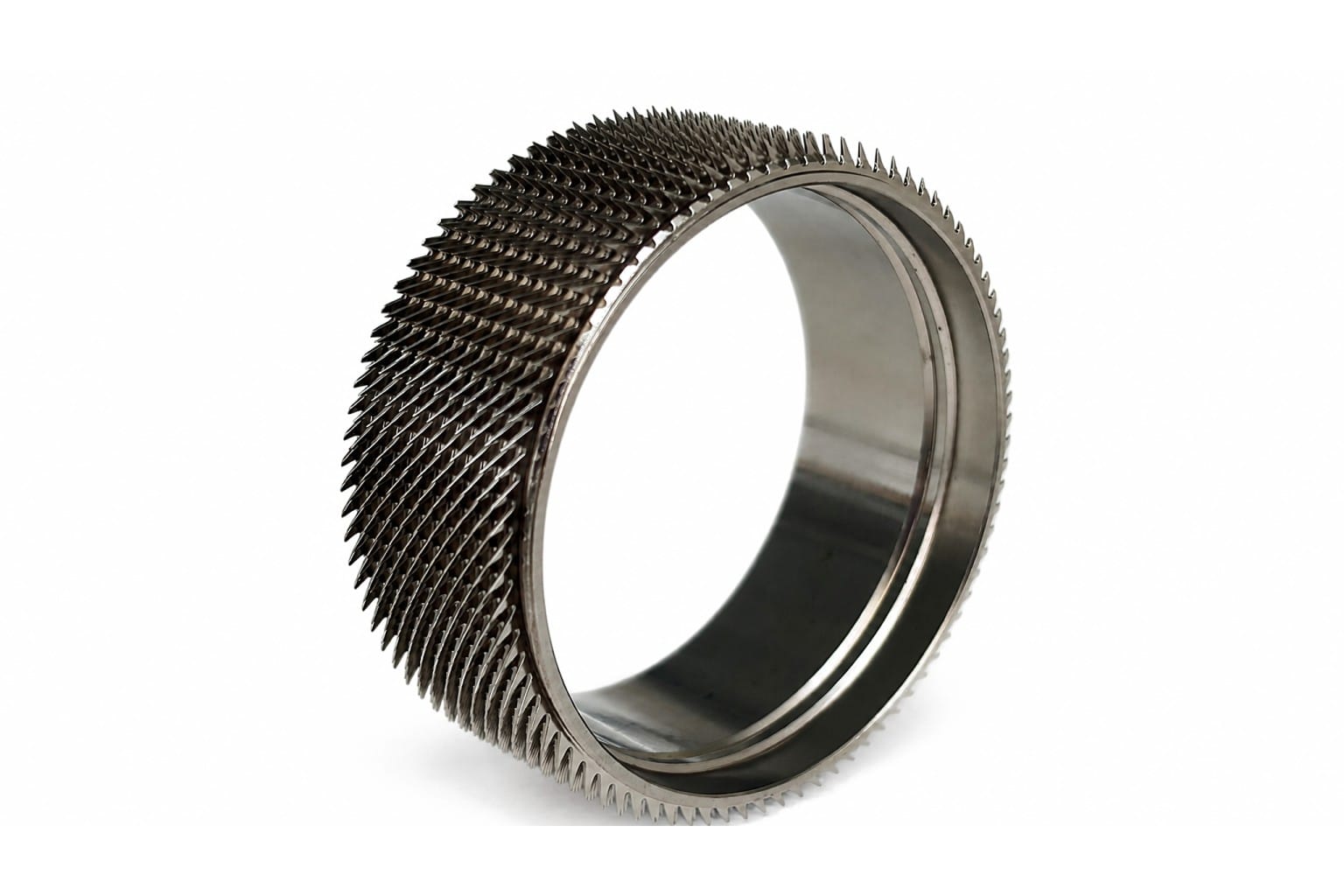
OB20DN Solid Ring — OB20 (B20) Tooth Profile Clothing Ring
One-piece clothing ring in the OB20 tooth profile (also designated B20) with a DN diamond-nickel working surface (HV 1000-1200). The cotton-ring counterpart to our flax and viscose profiles — carded and combed cotton open cleanly, and the tooth band resists loading at full combing roller speed.
OB20DN — Complete Specifications
OB20 is the B20 tooth type under JSM’s opening-roller designation. Both names describe the same profile — quote whichever your catalogue uses and we will match it.
Why OB20 for Carded and Combed Cotton
OB20 is the cotton and flax profile in the JSM solid ring range — the same tooth type sold elsewhere as B20. It opens carded and combed cotton cleanly and keeps its form on the viscose blends that make a coarser tooth band load up.
One ring that covers the whole cotton file, not just carded counts
Plenty of mills run carded cotton and combed cotton on the same machine and change rings with the schedule. OB20 covers both, and takes viscose blends as well. If your programme is viscose-dominant, tell us at the enquiry — we will say plainly whether OB20 is the profile to hold or whether another type in the range gives you a longer service interval.
Cotton-specific tooth spacing
Cut for carded and combed cotton, and for cotton/flax blends — opens the sliver without stripping short fibre out of the strand.
DN diamond-nickel surface
HV 1000-1200. Diamond co-deposited in a nickel matrix for wear resistance and low friction on the tooth tips.
One-piece concentricity
Ring and tooth band machined as a single part, so the profile runs true at 7,500-9,000 rpm combing roller speed.
Viscose-acceptable
Viscose blends run acceptably on OB20. On a viscose-dominant mix we will confirm whether a different profile holds its edge longer.
What DN Means on a JSM Solid Ring
Every ring in this range carries a DN working surface: diamond grit co-deposited inside a nickel matrix, HV 1000-1200. The earlier plain-nickel tooth types have been withdrawn — catalogue numbers ending in N are no longer produced or quoted.
Diamond grit is co-deposited inside a nickel matrix rather than simply plated on top. The result is a hard, low-friction working surface that holds its tooth form far longer than plain nickel on abrasive fibre, keeps the tooth tips from loading up with fibre and dust, and holds concentricity across a longer service interval.
The earlier plain-nickel tooth types are no longer produced, and catalogue numbers ending in N are not quoted. Order the DN version of the same tooth profile instead: identical tooth geometry and fit, with the diamond-nickel working surface. If you are holding stock of an N-type ring, send us the number and we will cross it to the current DN equivalent.
Which Machines Use OB20DN?
The same tooth profile is supplied in both machine platforms. The part number differs, so quote your machine model with the enquiry and we supply the matching configuration.
Running Taitan, Jingwei, Rifa or Saurer machines? The solid ring range in this catalogue is built for the Schlafhorst and Rieter platforms listed above, so we will not claim it fits a machine we have not checked. Send us the machine model and the part you are replacing and we will confirm whether a ring from this range fits, or supply the correct opening-roller component.
What to Spin with OB20DN
OB20 is the cotton-side profile. Match it to the fibre, not to the machine brand — the same tooth type is supplied in a Schlafhorst and a Rieter NG64 configuration.
All 7 Tooth Profiles — Where OB20DN Sits
Every profile in the range is DN coated and covers Schlafhorst Autocoro SE8–SE20. B-series profiles are cotton and natural-fibre oriented, S-series profiles are built for synthetics. Your current model is highlighted.
| Tooth Profile | Coating | Fibre Direction | Page |
|---|---|---|---|
| B174 / B174-2 | DN | Carded cotton and flax blends (best); combed cotton, viscose (OK); not for P/C or synthetic blends | View page |
| B187 | DN | Combed cotton, viscose (best); blends (OK); not for carded cotton, acrylic or flax | On request |
| B300 | DN | Newer tooth type — application data under confirmation | View page |
| OB20 (B20) | DN | Carded and combed cotton, flax blends (best); viscose (OK); not for pure synthetic fibres | View page |
| OS21 (S21) | DN | Polyester, viscose, acrylic and P/C blends (best); cotton (OK); not for flax | View page |
| S43 | DN | Polyester, P/C and P/V blends (best); not for cotton, viscose, acrylic or flax | On request |
| OK61 | DN | Newer tooth type — application data under confirmation | On request |
Rieter R40 / R60 / R66 machines take the same tooth profile in a separate NG64 configuration. It is not interchangeable with the Schlafhorst ring even though the tooth geometry looks identical, so quote your machine model with the enquiry and we will supply the matching configuration.
B-series tooth types suit cotton and natural fibres; S-series tooth types suit synthetics. Where a profile needs its fibre recommendation confirmed against your own schedule we say so rather than publish a general claim. Not sure which profile you are running? Send a photo of the worn ring and the machine model and we will identify it.
OB20DN — Frequently Asked Questions
The questions mills ask most often about this ring. Anything not covered here, ask directly — we answer with the part number and the price, not a brochure.
What is the difference between OB20 and B20?
Which machines does OB20DN fit?
What fibres does OB20DN suit best?
What does DN mean?
How do I know I am ordering the right profile?
Send Us Your Machine Model and Fibre Mix
Pre-filled: OB20DN · OB20 tooth profile
Tell us your machine model, the ring position and your fibre mix. We confirm the profile, price and lead time within 24 hours. Sample orders welcome.
No spam · Your information stays private · Leo Wang replies personally