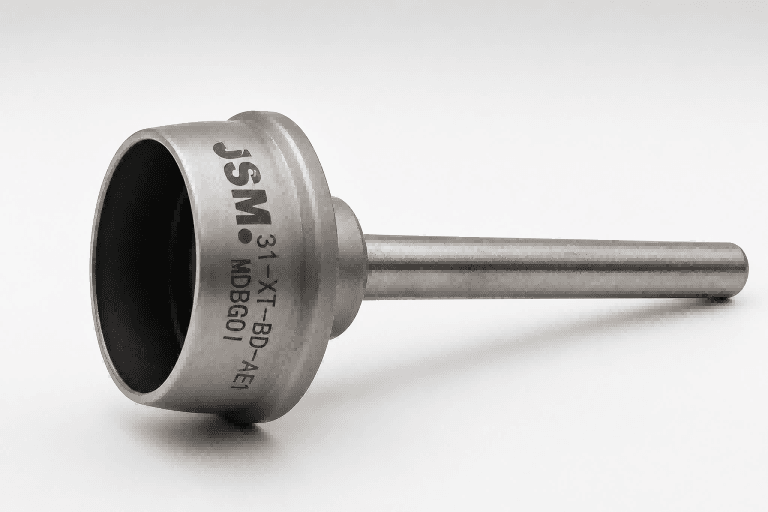
40-D III-D Rotor Complete
D III rotor complete on the R20 Twin Disc bearing, count confirmed per order on the Rieter R1, R20, R40 and R60 fully automatic platform. Diamond top layer on the prepared substrate. Every assembly is dynamically balanced and vibration-checked before shipment, at 40–60% below the OEM part price.
40-D III-D — Complete Specifications
All measurements in millimetres. Every rotor complete assembly is 100% dynamically balanced on our own balancing line before shipment.
Why D III Groove for Application-Specific Spinning
The D III groove is matched per application rather than to a published band. The R20 Twin Disc bearing settles the machine side; the count window is confirmed for your order. Rotors in this group share that groove and differ by cup diameter, so the groove can stay constant while the count moves.
D III Groove — Yarn Count Range
The count band is confirmed per order. Include your target Ne, fibre type and spinning position with the enquiry. Groove and cup size are confirmed together when the order is placed.
D III Groove — Machine Fit Fixed, Count Confirmed
The bearing settles machine fit; the groove is confirmed against the job. For the D III code that means quoting on your application rather than on an assumed Ne range, which is the only way to avoid sending the wrong rotor to the spinning position. Send the fibre, the target count and the spinning position and the selection is confirmed before quoting.
Cup Size From the Code
The leading number gives the cup diameter in millimetres, so the rotor size is unambiguous.
Quotation Follows the Selection
Price and lead time are quoted on the confirmed selection, not on an assumption.
Count Matched to Your Application
The rotor is checked against your fibre, target count and spinning position rather than an assumed band.
Engineer-Confirmed Selection
Groove, cup size and coating are confirmed together before the order is released.
What D Means: Base and Working Surface
The trailing letters of the model code are two independent codes, not one word: B is the substrate, D is the working surface. The D in the code is the diamond top layer — the face that takes the fibre and grit contact. On the -BD- models that same layer sits on a boronized base. Every assembly is 100% dynamically balanced before it leaves the balancing line.
B = boronized (boron-steel) substrate. A diamond film is only microns thick, so the steel underneath decides whether it survives: a soft substrate deforms under fibre and grit impact and the film cracks and spalls off. The boronized base is the hardening step that keeps the diamond layer intact. This code does not carry the B step; it is the -BD- variant that pairs the diamond layer with the boronized base.
D = diamond top layer, grown on the prepared substrate as a micron-scale film. It takes the fibre and grit contact directly, which is where the wear resistance, the friction coefficient of 0.05–0.1 and the anti-stick behaviour come from that hold the groove profile over long runs. Diamond coating technology of US origin, applied on JSM’s own treatment line.
Which Rieter Machines Use 40-D III-D?
For this group the rotor is shared across machine generations: the R20 Twin Disc bearing serves the Rieter R1, R20, R40 and R60 series, so one rotor part number covers four platforms.
What to Spin with 40-D III-D
Typical operating profile for the D III groove on the Rieter R1, R20, R40 and R60 fully automatic platform. Groove count windows follow the catalogue data.
✓ Applications outside the standard published count bands
✓ Rieter R1, R20, R40 and R60 spinning positions
✓ Replacing a rotor at a known position
◇ Standard fine counts Ne 16–40 — T family, published window
◇ Medium–coarse Ne 10–30 — U general-purpose groove
◇ Blends and speciality fibres — S groove
→ S: Special (Ne 16–40)
→ U: General purpose (Ne 10–30)
→ GL: Large (Ne 3–16)
→ G: Standard (Ne 16–40)
→ T: Narrow (Ne 16–40)
→ TT: Extra narrow (Ne 16–40)
→ See all 6 Rieter R1, R20, R40 and R60 rotor models →
40-D III-D — Frequently Asked Questions
Answers to the questions buyers ask most often about this rotor. If yours is not listed, send it with your machine model and current rotor code — we reply within 24 hours.
Is 40-D III-D compatible with my Rieter R1, R20, R40 and R60 machine?
What does the model code 40-D III-D mean?
What yarn counts does the D III groove suit?
What do the letters BD mean in the model code 40-D III-D?
How much does an OEM-equivalent rotor save versus the original?
Can I order the rotor spindle or rotor cup separately?
Order 40-D III-D Rotors
Pre-filled: 40-D III-D · Rieter R1 / R20 / R40 / R60 · diamond coating
Tell us your quantity and we respond with pricing, lead time and freight options within 24 hours. Sample orders welcome.
No spam · Your information stays private · Leo Wang replies personally