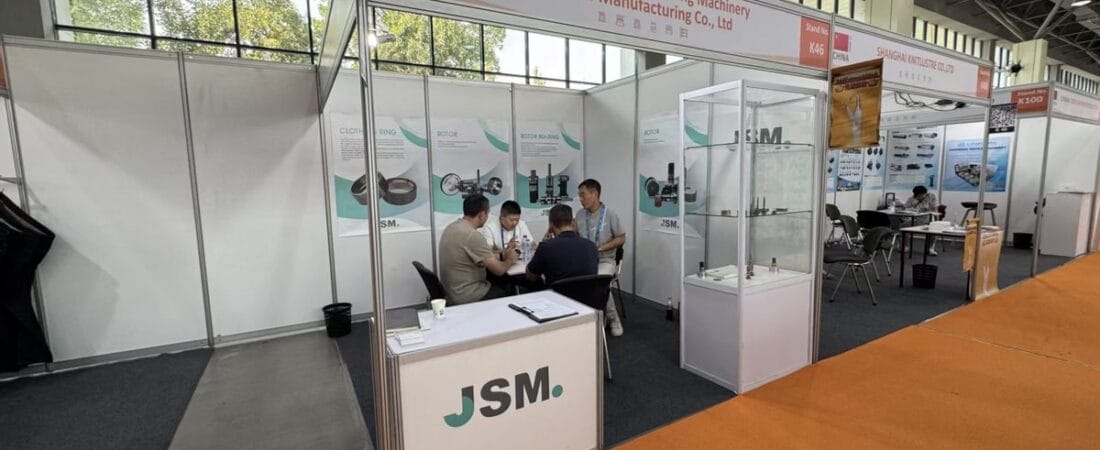
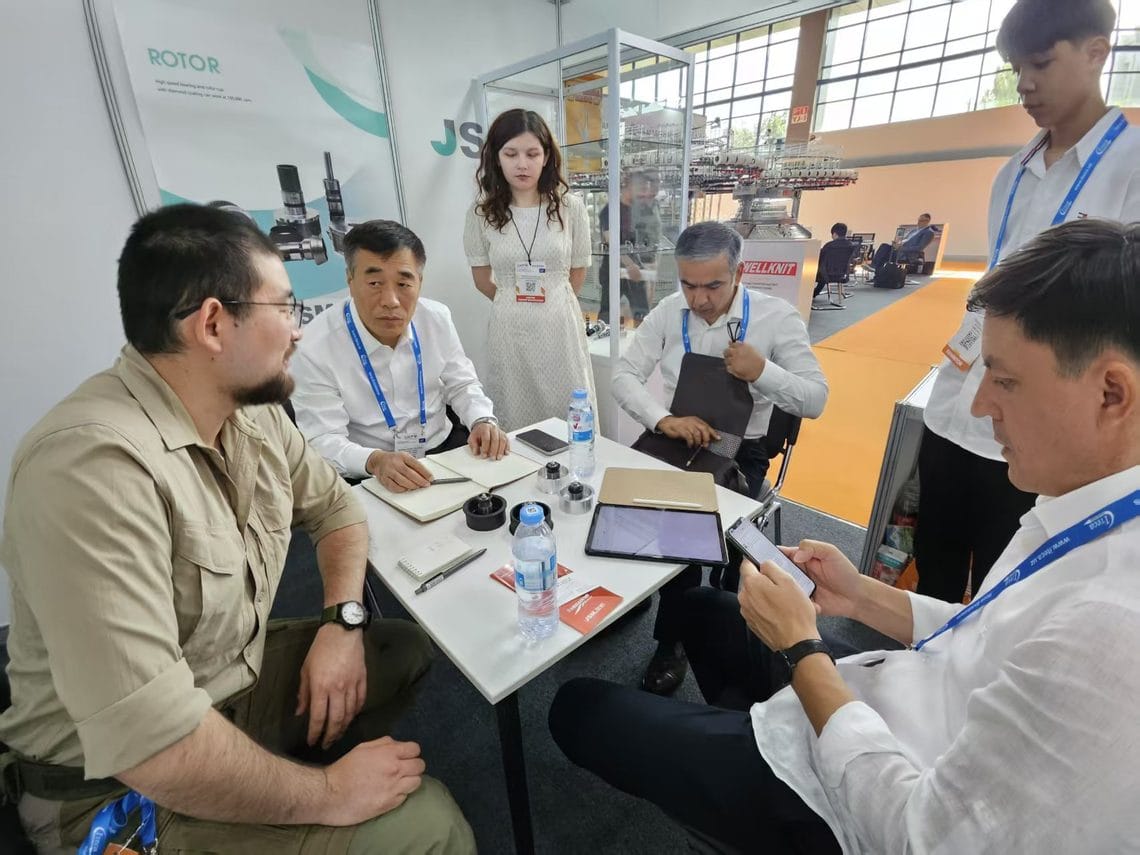
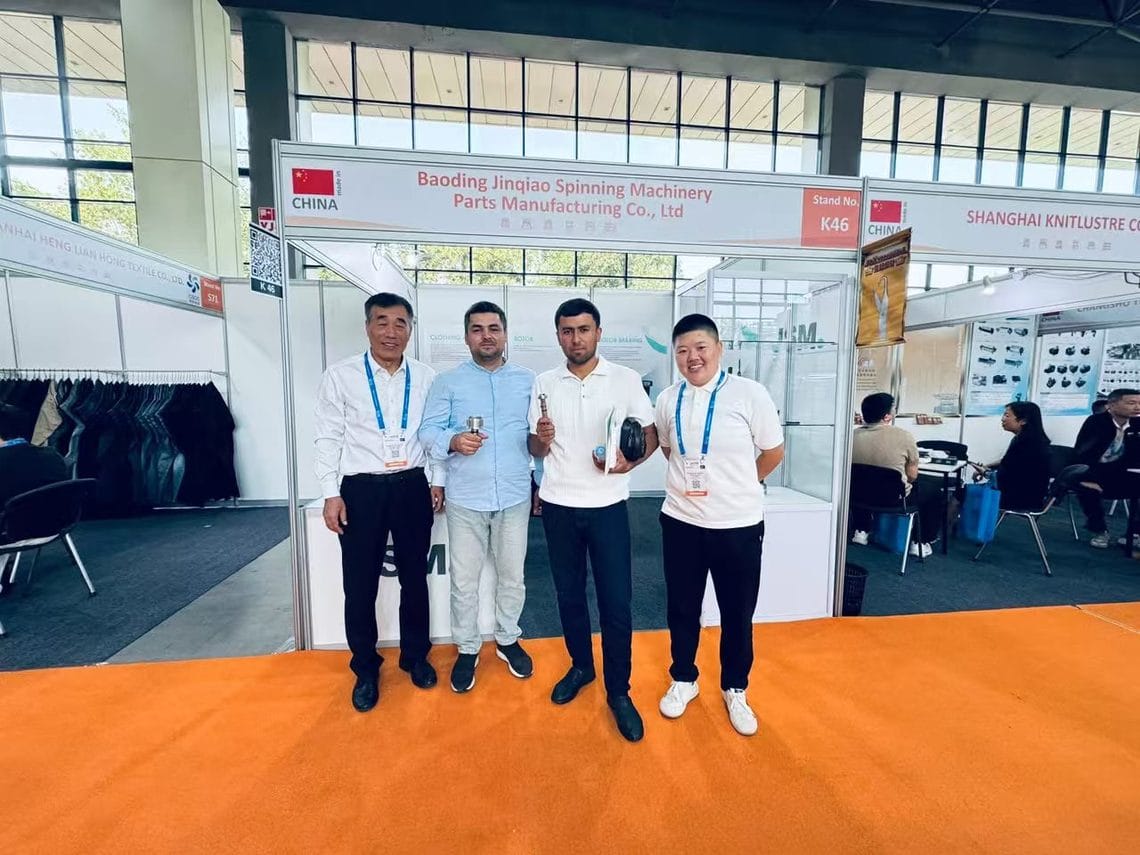
The 17th Central Asian International Textile Machinery Exhibition — CAITME 2026 — closed on 10 September at the Uzexpocentre in Tashkent. Ten days later, we are still unpacking the most useful thing we brought home: not samples, not brochures, but a signed supply agreement with an open-end spinning mill in Uzbekistan.
We are not going to publish the mill’s name. What we will publish is the engineering behind the decision, because the same questions came up in almost every technical conversation on that stand — and they are the exact questions Pakistan’s rotor spinners will be asking when IGATEX Pakistan 2026 opens at the Expo Centre Lahore on 15–18 October.
If you run Autocoro, R-series, BD-series, Taitan, Jingwei or Rifa open-end machines and you have ever wondered whether an OEM-grade alternative part is worth the risk, this article is the long answer. The short answer is in the tables below.
What Came Out Of Tashkent
CAITME is Central Asia’s largest textile machinery exhibition, and the 2026 edition put the region’s investment story on full display. Uzbekistan and Pakistan were both named among the six largest investors in short-staple spinning capacity worldwide in ITMF’s latest machinery shipment statistics — alongside China, India, Bangladesh and Indonesia.
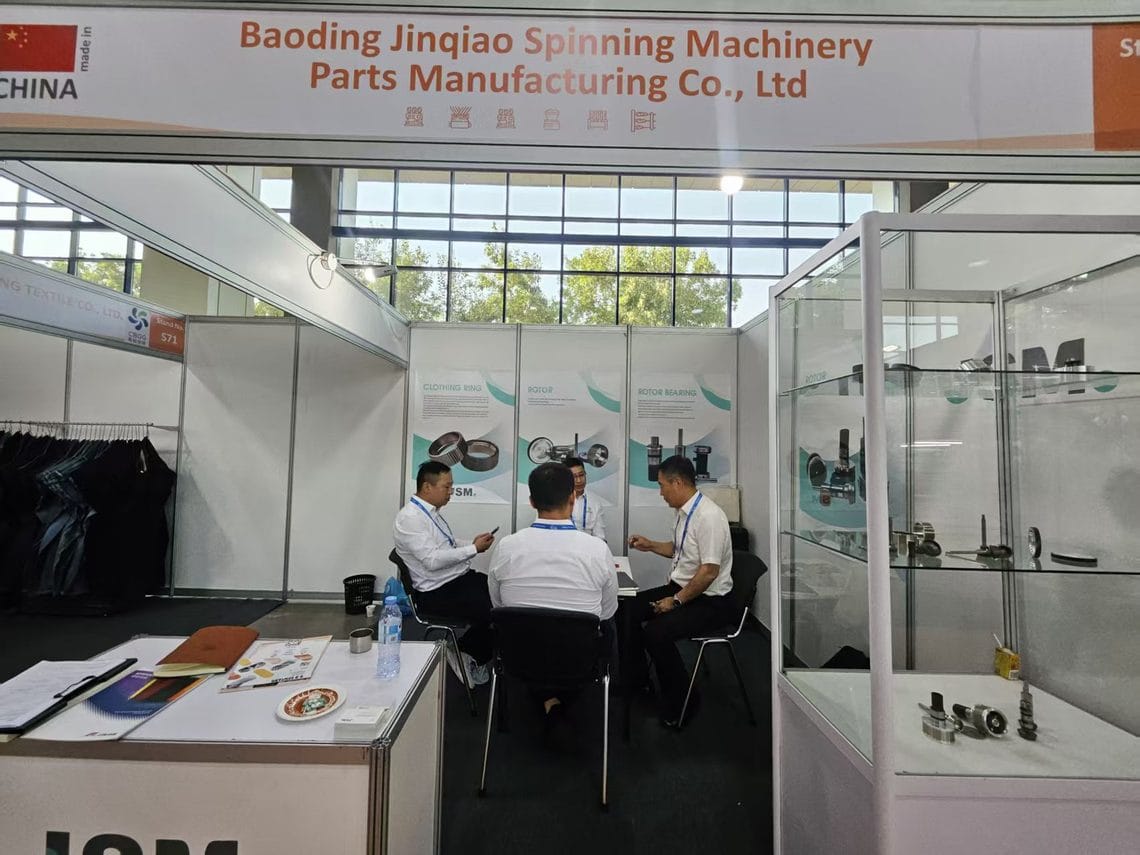
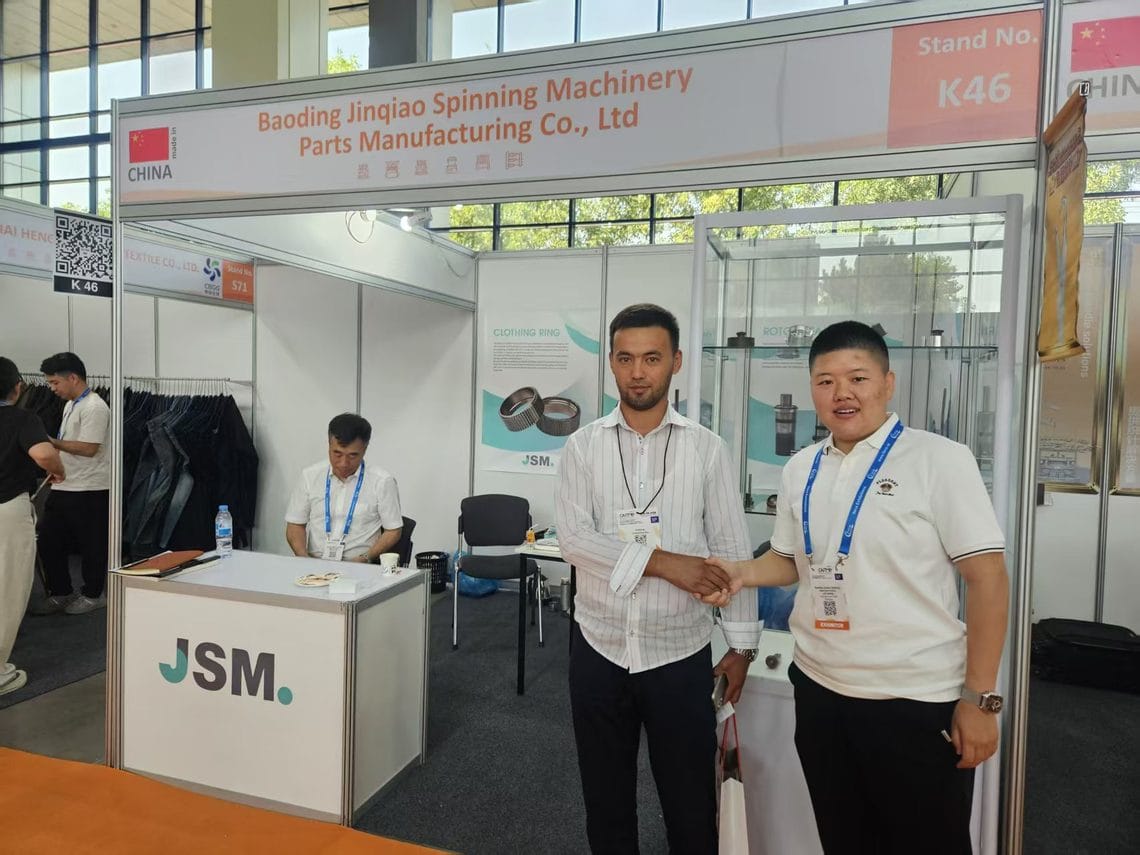
We exhibited as Baoding Jinqiao Spinning Machinery Parts Manufacturing Co., Ltd — the manufacturing company behind the JSM brand — at Hall 4, Stand K46. Three days, one stand, and a parts display case that did most of the talking.
That is the macro picture. The micro picture is what happens on a mill floor at 3 a.m. when a rotor cup is out of balance, yarn quality drifts, and the maintenance team is arguing about whether the part they just fitted is genuine.
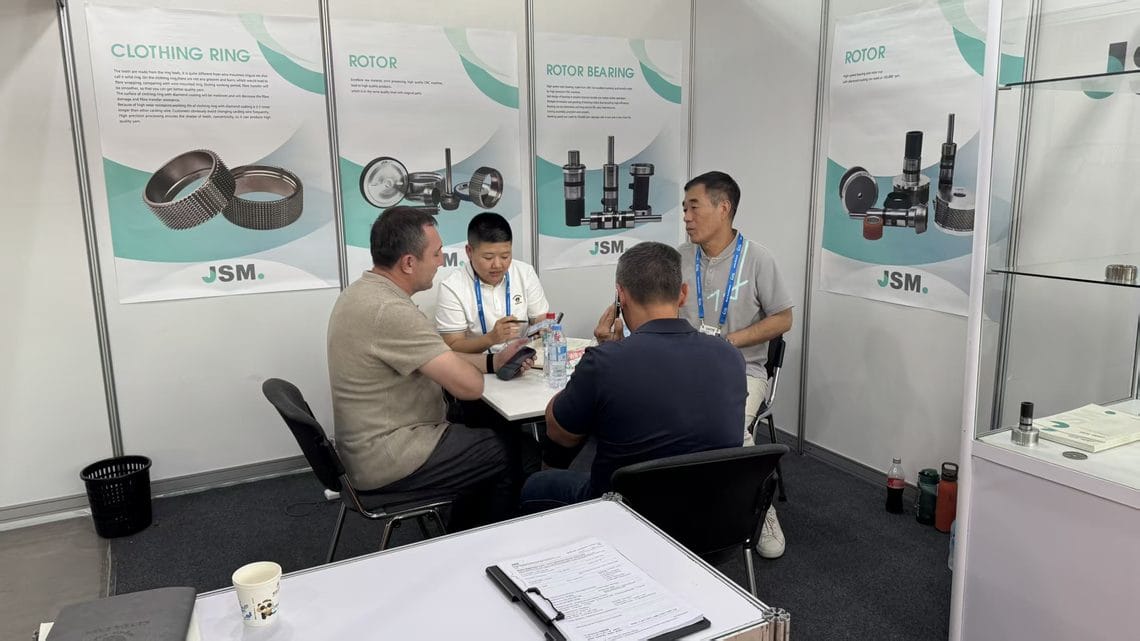
Everything we discussed in Tashkent came back to that. So did the order.
For a fuller look at the Uzbek market — mill counts, installed rotor base, and what is actually driving replacement demand — see our earlier analysis: Uzbekistan’s textile market in 2026 and what it means for rotor spinning spare parts.
Three Technical Points That Decide Most Evaluations
1. “BD” and “Diamond” are not competing claims — they describe different layers
This one causes more confusion than any other question we get, including from experienced maintenance managers.
On a Rieter-format rotor, a code ending in -BD- means two separate things stacked on top of each other:
- B = boronized base. A hardened substrate. Diamond film is only microns thick; if the substrate underneath is soft, cotton dust and micro-sand deform it, and the outer coating fractures and spalls off. The boronized layer gives the coating something rigid to sit on.
- D = diamond coating (vapour-deposited, DLC). This is the layer that actually meets the fibre and the abrasive particles: wear resistance, very low friction, resistance to cotton deposit build-up.
So -BD- = boronized base plus diamond coating. A code with only -D = diamond coating on a standard base.
Yes, the official catalogue writes “Diamond” and some technical pages write “BD Boronized”. Both are correct. They are describing one layer each. Nothing is being hidden — but if a supplier only ever mentions one of the two, you now know to ask about the other.
2. Full-automatic rotors run diamond or nothing
Rotor speed determines the coating decision, and there is no room for improvisation here.
Full-automatic machines — Schlafhorst Autocoro and equivalents — run rotor speeds high enough that only diamond coating is viable. Nickel coating is not an option on these machines, and any supplier who offers you a nickel-coated rotor for an Autocoro is either misunderstanding your machine or hoping you are. Nickel coatings belong on medium- and low-speed semi-automatic machines such as the Taitan and Rifa platforms.
Our diamond-coated cups are specified at HV 1000–1200 surface hardness. Ask for that number when you compare suppliers. It is a measurable, testable figure, and it separates real coating capability from a coating line that was outsourced.
3. Concentricity and dynamic balance decide yarn quality before the coating does
A coating argument is irrelevant if the rotor does not run true. Rotor cup concentricity and dynamic balance are what keep high-speed running stable: they drive rotor vibration, they drive end-breakage rate, and they drive whether your yarn evenness holds across a full doff.
This is why dynamic balance testing sits in our process rather than at the end of it, and why full in-house production — from machining through coating — matters more than the price difference you see on a quotation sheet. A supplier who machines in one place, coats in another, and balances nowhere is selling you a delivery date, not a component.
Uzbekistan And Pakistan: Two Of ITMF’s Six Largest Investors
The reason this order and this next exhibition belong in the same article is that both markets are investing at the same time.
| Data point | Figure | Period | Source |
|---|---|---|---|
| Open-end rotors shipped worldwide | 645,000 units (≈50,000 more than 2024) | 2025 | ITMF ITMSS 2025 (48th edition, published 28 July 2026) |
| Share of rotor shipments going to Asia & Oceania | 94% (607,000 units, +9% year on year) | 2025 | ITMF ITMSS 2025 (48th edition) |
| Largest short-staple spinning investors | China, India, Bangladesh, Indonesia, Uzbekistan, Pakistan | 2025 | ITMF ITMSS 2025 (48th edition) |
| Installed open-end rotor positions, worldwide | 9.7 million | 2023 | ITMF, International Textile Industry Statistics, published December 2024 |
| Installed open-end rotors, Uzbekistan | 242,000 | 2023 | GIZ, “A Textile Giant in the Making?” (2024) |
| Pakistan textile sector share of national exports | ~60% | latest reported year | Pakistan Bureau of Statistics / PTEA, as cited by the IGATEX Pakistan 2026 organizer |
Note on sources: ITMF’s 2025 release reports both an increase of about 50,000 rotor units and a +3.5% year-on-year figure for the same period. The unit figure is quoted above.
Read the first three rows together and the commercial logic is straightforward: the global rotor fleet grew again in 2025, almost all of that growth landed in Asia, and Pakistan is one of the six countries driving it.
A rotor cup is a consumable, not a capital asset. Every one of those newly installed rotors will need replacement cups, opening rollers and bearings for the life of the machine — on a cycle measured in months, not years. The decision you make about who supplies those parts compounds every single month.
What Pakistan’s Rotor Spinners Actually Run
Pakistan’s installed base is not one brand. That matters, because a supplier who only carries Schlafhorst-format parts cannot serve a mill that also runs Saurer and Taitan lines — and a supplier who only talks about European brands has not walked a Pakistani spinning floor.
| Machine platform | Coverage on our side | Where to look |
|---|---|---|
| Schlafhorst Autocoro (SE7–SE20) | Rotor complete, rotor cup, rotor bearing, solid ring (SE8–SE20 common) | Autocoro rotor complete assemblies |
| Rieter R-series (R1 / R20 / R40 / R60 / R66) | Full rotor cup range in BD and D formats, NG64-format solid rings | Rieter R-series rotor complete |
| Saurer BD-series (BD320 / 330 / 350 / 380 / 416 / 448 / 6 / 7) | T34-format rotor complete assemblies and cups | Saurer BD series rotor complete assemblies |
| Taitan / Jingwei / Rifa | Rotor cups, opening rollers, solid rings in nickel and diamond specification | Taitan / Rifa / Jingwei compatible parts |
| Opening & carding side | Opening roller complete, opening roller bodies, bearings, clothing strips, carding wire | Opening roller components, clothing ring, carding wire |
| Rotor bearings | 13 models, shaft diameters Φ8 / 8.9 / 10 mm, speed range 60,000–120,000 rpm | Rotor bearings |
One practical note on ordering by name: the same component is called different things depending on whose machine you run. A combing roller on a Schlafhorst is an opening roller on a Rieter. A rotor spindle is a rotor shaft. If you send us a photograph and the machine model, we will confirm the part number rather than guess — it is the single fastest way to avoid a wrong shipment.
Rotor Cup Groove Type By Yarn Count
Groove geometry, not diameter alone, decides whether a rotor can spin your count. This is the reference table we use when a mill sends us a yarn specification without a part number.
| Groove type | Yarn count range | Typical use |
|---|---|---|
| GL | Ne 3–16 (coarse) | Large-diameter, coarse yarn |
| GT | Ne 3–30 (coarse to medium) | Wide groove, coarse-to-medium counts |
| U | Ne 10–30 (approx. 20–60 tex) | Medium-to-coarse range |
| G | Ne 16–40 (medium to fine) | Medium-to-fine counts |
| S | Ne 16–40 (medium to fine) | Medium-to-fine counts |
| T | Ne 16–40 (medium to fine) | Medium-to-fine counts |
| T-B5 | Ne 16–40 (medium to fine) | Narrower T variant |
| TT | Ne 16–40 (medium to fine) | Narrower-groove T variant |
| K | Ne 30–40 (fine) | Fine counts |
Count bands: coarse = Ne 3–16, medium = Ne 16–30, fine = Ne 30–40.
For the diameter side of the same decision, see our rotor cup diameter matching guide and how to choose the right rotor cup for open-end spinning.
Solid Ring: B-Series For Cotton, S-Series For Synthetics
On the opening end, the whole ring (solid ring) does the fibre opening work, and the choice between the two main geometry families is a fibre question.
| Ring | Best performance | Acceptable | Not recommended |
|---|---|---|---|
| B174 / B174-2 | Carded cotton, linen blends | Combed cotton, viscose | Polyester, acrylic, blends |
| B20 | Carded & combed cotton, linen blends | Viscose | Polyester, acrylic, blends |
| B187 | Combed cotton, viscose | Blends | Carded cotton, acrylic, linen |
| S21 | Polyester, viscose, acrylic, blends | Cotton | Linen |
| S43 | Blends, 100% polyester | — | Cotton, viscose, acrylic, linen |
In short: B-series is the cotton and natural-fibre family; S-series is the synthetic family. Both are available in DN diamond specification. For a Rieter R40 / R60 / R66 installation, that means the NG64-format ring; for Schlafhorst SE8–SE20, the same ring design is common across the series.
Additional ring profiles are available on request — send us your fibre blend and we will send back the matching sheet.
What A Working Order Looks Like
We keep the commercial part simple, because in this business the technical part is already complicated enough.
- MOQ: from 300 pieces per item. Mixed assortments are workable for trial orders — ask.
- Quote turnaround: within 24 hours of receiving machine model, part number or photo, and quantity.
- Documents: full export documentation, and we will tell you exactly which Inco term fits your country rather than quoting one and correcting it later.
- Engineering support: if you have yarn unevenness, end breaks or cotton deposits, send the details. Rotor selection, coating choice and process parameters are engineering problems, and we treat them that way. This is not a parts catalogue support line.
Start here: contact us with your machine model and what you need replaced.
Meet Us At IGATEX Pakistan 2026
We are exhibiting at IGATEX Pakistan 2026, 15–18 October 2026, Expo Centre Lahore (daily 10:30–18:30), at Stand H-3-29.
If you are planning to attend, here is the useful part: book a slot before the show instead of queueing at the stand. Send us your machine list and the parts you are currently replacing, and we will come to the meeting with your rotor cup options, coating specification and indicative pricing already prepared. Thirty focused minutes beats a badge scan and a brochure.
WhatsApp / WeChat: +86 131 8004 8511 · Email: leo@jsmspinning.com · Web: jsmspinning.com
If you are in Faisalabad, Lahore or Karachi and cannot make the show, write to us anyway — we work with mills and distributors in all three clusters.
FAQ
Do you supply OEM-grade alternatives for Schlafhorst Autocoro rotors?
Yes. Rotor complete assemblies and rotor cups for Autocoro SE7 through SE20, in diamond specification, plus rotor bearings and solid rings for the SE8–SE20 series.
Which coating should I choose for a full-automatic rotor?
Diamond. Full-automatic machines run rotor speeds where nickel coating is not viable, so we do not offer nickel on those platforms. Nickel coatings are for medium- and low-speed semi-automatic machines such as Taitan and Rifa.
What is the difference between the part codes ending in -BD- and -D?
-BD- means a boronized (hardened) base with a diamond coating on top. -D means a diamond coating on a standard base. The boronized base prevents the thin diamond layer from deforming and spalling under fibre and micro-sand impact.
How fast can you quote for a Pakistani mill?
Within 24 hours, provided we have the machine model plus a part number, a photo of the worn part, or the yarn specification. Orders start from 300 pieces per item, and we can structure a trial mixed assortment.
Do you support Taitan, Jingwei and Rifa machines, or only European brands?
All three. A large share of Pakistan’s rotor spinning capacity runs non-European platforms, and we stock rotor cups, opening rollers and solid rings for them in both nickel and diamond specification.